


HR Hiring Trends in 2026: What Employers Need to Know to Stay Competitive
The hiring landscape in 2026 is being reshaped by rapid technological advancements, tighter compliance requirements, and a workforce that expects more transparency and flexibility than ever before. Organizations are no longer just competing for talent; they are competing on how efficiently, securely, and thoughtfully they hire. These evolving HR Hiring trends in 2026 are redefining what successful recruitment looks like across industries.
HR leaders and hiring managers are under increasing pressure to make faster decisions without compromising accuracy or compliance. From verifying candidate identities in a remote environment to ensuring every step of the hiring process meets regulatory standards, the stakes have never been higher.
At the same time, candidates are more selective, informed, and experience-driven. Companies that balance speed with diligence, while maintaining a strong candidate experience, are the ones gaining a clear competitive edge in today’s market.
1. Skills-Based Hiring Is Replacing Degree Requirements
One of the most significant HR hiring trends in 2026 is the shift toward skills-based hiring. Employers are placing less emphasis on traditional degrees and more focus on verified skills, certifications, and real-world experience. This approach helps organizations identify candidates who can perform from day one, especially in fast-moving or technical roles.
By broadening candidate criteria, companies are also opening doors to more diverse talent pools. This creates opportunities for individuals who may not follow a traditional academic path but bring strong, job-ready capabilities. As a result, hiring teams are rethinking job descriptions, assessment methods, and qualification benchmarks.
However, this shift increases the importance of accurate verification. Employers must ensure that claimed skills, certifications, and experience are legitimate. Reliable employment verification and credential checks play a critical role in making skills-based hiring both effective and secure.
2. Background Checks Are Becoming More Comprehensive
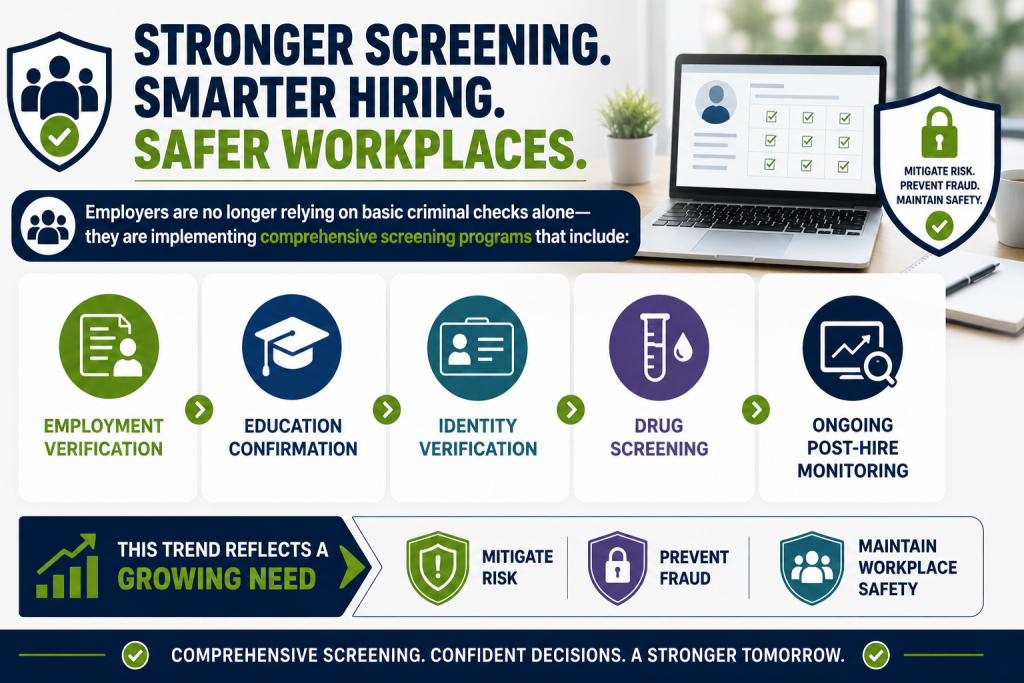
As hiring becomes more competitive and remote, companies are strengthening their background screening processes. Employers are no longer relying on basic criminal checks alone, they are implementing comprehensive screening programs that include:
- Employment verification
- Education confirmation
- Identity verification
- Drug screening
- Ongoing post-hire monitoring
This trend reflects a growing need to mitigate risk, prevent fraud, and maintain workplace safety.
3. Identity Verification Is Critical in Remote Hiring
With remote and hybrid work continuing to dominate, verifying a candidate’s identity has become a top priority. Cases of identity fraud and misrepresentation have increased, making it essential for organizations to adopt secure verification methods.
Tools such as Social Security verification (SSA-89), ID authentication, and digital identity solutions are now standard in modern hiring workflows.
4. Compliance and Fair Hiring Practices Take Center Stage
Regulatory compliance remains a cornerstone of effective hiring. Employers must navigate laws such as the Fair Credit Reporting Act (FCRA), ban-the-box regulations, and state-specific screening requirements.
In 2026, organizations are investing more in compliant hiring processes to avoid legal risks and protect their brand reputation.
Best practices include:
- Providing clear disclosures and obtaining consent
- Using consistent screening criteria
- Partnering with compliant background screening providers
5. Faster Hiring Through Automation and Integration
Speed is a competitive advantage in today’s hiring market. As part of the broader HR hiring trends in 2026, HR teams are leveraging automation, applicant tracking systems (ATS), and integrated screening solutions to reduce time-to-hire without compromising quality. Faster processes help ensure top candidates are not lost to competitors.
Automation also improves consistency and reduces manual errors. Background checks, employment verifications, and identity screening can now be triggered automatically within hiring workflows. This aligns with emerging HR hiring trends in 2026, where efficiency and compliance are becoming equally important. It also allows HR teams to focus more on decision-making and candidate engagement rather than administrative tasks.
At the same time, integration is key. When screening tools work seamlessly with ATS platforms, organizations gain better visibility, faster turnaround times, and improved compliance tracking. The result is a hiring process that is both efficient and reliable, reflecting the ongoing evolution of HR hiring trends in 2026.
6. Candidate Experience Is a Top Priority
Today’s candidates expect transparency, speed, and professionalism throughout the hiring process. Delays or unclear communication can result in losing top talent.
Employers are focusing on:
- Clear communication during screening
- Mobile-friendly application processes
- Faster turnaround times for verifications
A smooth candidate experience not only improves hiring outcomes but also strengthens employer branding.
7. Data Security and Privacy Are Non-Negotiable
With increased data collection comes greater responsibility. HR departments are handling sensitive personal information, including Social Security numbers, employment history, and identity documents. Protecting this data is essential to maintaining trust and avoiding legal exposure.
Organizations are investing in secure platforms, encrypted data storage, and strict access controls to safeguard candidate information. Compliance with data protection regulations is no longer optional, and companies must ensure their vendors follow the same high standards.
A strong data security strategy also reinforces employer reputation. Candidates want to know their information is handled responsibly. By prioritizing privacy and security, organizations not only reduce risk but also strengthen their credibility in a competitive hiring market.
Partnering for Smarter Hiring
As HR hiring trends continue to evolve, organizations that prioritize verification, compliance, and efficiency will have a clear advantage. Implementing strong background screening and identity verification processes is no longer optional, it’s essential.
Partnering with a trusted provider like Private Eyes can help streamline your hiring and lending verification processes. From comprehensive background checks to IRS transcript verification and identity solutions, having the right partner ensures your organization makes informed, secure decisions every time.
Staying ahead in 2026 means hiring smarter, verifying thoroughly, and protecting your organization at every step.
Key Takeaways
- Skills-based hiring is replacing traditional degree requirements.
- Employers are prioritizing verified skills and real-world experience.
- Background screening processes are becoming more comprehensive.
- Identity verification is critical in remote and hybrid hiring.
- Compliance and fair hiring practices are more important than ever.
- Automation is helping companies speed up hiring decisions.
- Integrated hiring systems improve efficiency and reduce errors.
- Candidate experience plays a major role in attracting talent.
- Data security and privacy are essential in modern hiring.
- Strong verification processes help reduce hiring risks.
- Trusted screening partners help organizations hire smarter.
Have questions? Speak to a Private Eyes expert for more information.